
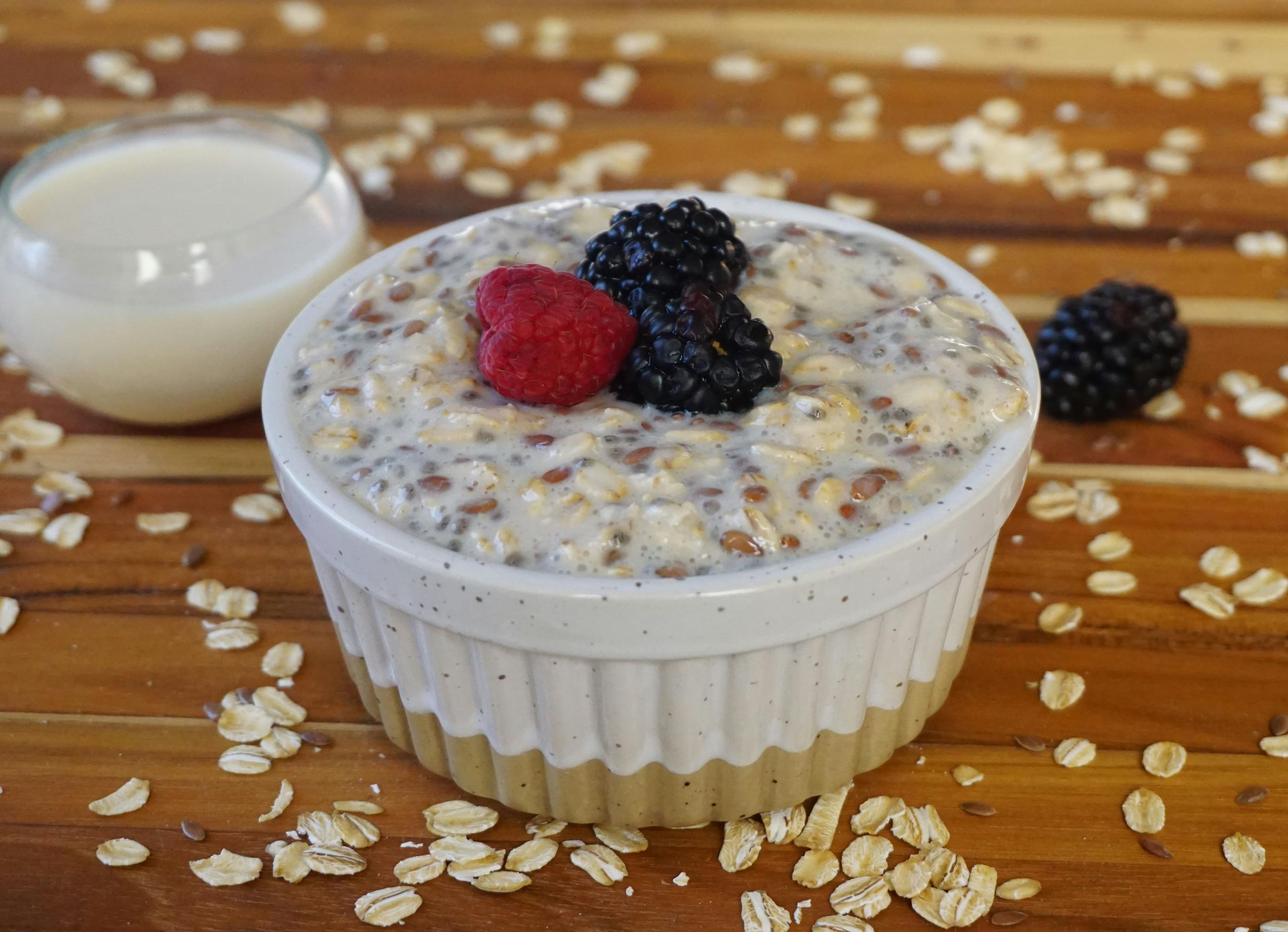
If there's one breakfast that earns its place at the top of every fiber-maxxing list, it's overnight oats. It's quick to prepare, endlessly customizable, and — when built right — one of the most gut-diverse single meals you can eat.
But most overnight oat recipes stop at oats, milk, and maybe some berries. That's a decent start. With a few strategic additions, you can turn a basic bowl into a microbiome-feeding powerhouse that hits 12–15g of fiber and counts 6–8 different plant sources before 9 AM.
Here's how.
Why Overnight Oats Are a Gut Health Goldmine
The base — oats — is already doing serious work. Rolled oats are one of the richest sources of beta-glucan, a soluble fiber with more clinical evidence behind it than almost any other single fiber type. Three grams of beta-glucan per day (roughly one 80g serving of oats) is enough to:
- Blunt post-meal glucose spikes by slowing gastric emptying
- Feed Bifidobacterium and Bacteroides populations in the gut
- Lower LDL cholesterol (an FDA-recognized health claim)
- Stimulate production of butyrate via cross-feeding with Roseburia
The "overnight" part adds another layer. When oats soak in liquid for 8+ hours, the starch structure changes — a portion of it converts to resistant starch, which passes undigested to the colon where it acts as a prebiotic. Cold oats (eaten straight from the fridge rather than reheated) retain more of this resistant starch than warm ones.
One serving of overnight oats provides roughly 4–5g beta-glucan plus 1–2g of resistant starch — a combination that feeds at least three distinct bacterial populations before you've added a single topping.
The Fiber-Maxxing Formula
Building a gut-optimized bowl follows a simple layered approach. Each layer adds a distinct fiber type and bumps up your weekly plant count.
Base (pick one)
- Rolled oats — beta-glucan, resistant starch
- Oat + barley blend — beta-glucan from two distinct sources, higher prebiotic diversity
- Oat + buckwheat groats — adds arabinoxylan alongside beta-glucan
Liquid (pick one)
- Kefir — adds live cultures (probiotic) that work synergistically with the prebiotic fiber
- Oat milk — boosts beta-glucan further
- Plain yogurt thinned with water — probiotics + protein
Seeds (pick 1–2)
- Chia seeds (2 tbsp) — 10g fiber, gel-forming mucilage, omega-3s
- Ground flaxseeds (1 tbsp) — lignans (act as prebiotics), omega-3s, 2–3g fiber
- Hemp seeds — adds fiber variety without gel texture
Fruit (pick 1–2)
- Berries (raspberries, blackberries, blueberries) — pectin + polyphenols that directly modulate microbiome
- Green banana (sliced) — one of the richest resistant starch sources available
- Apple (grated, with skin) — pectin + quercetin, a prebiotic polyphenol
- Kiwi — uniquely high in actinidin, an enzyme that improves protein digestion and gut motility
Extras (pick 1–2)
- Walnuts or almonds — ellagitannins fermented by gut bacteria into urolithins (anti-inflammatory)
- Cacao nibs — high-polyphenol, gut-modulating compound distinct from other sources
- Dried mulberries or goji berries — novel fiber sources that count as separate plant points
- Cinnamon — polyphenols with prebiotic activity
5 Gut-Optimized Overnight Oat Recipes
Each recipe lists the plant count and fiber estimate so you can see exactly what you're getting before you add a single extra topping.
Recipe 1: The Classic Fibermaxxer
6 plants · ~14g fiber
Ingredients
- 80g rolled oats
- 200ml kefir
- 2 tbsp chia seeds
- 1 tbsp ground flaxseeds
- 80g raspberries
- 1 tbsp maple syrup
Method: Stir oats, chia, and flax into kefir. Refrigerate overnight. Top with raspberries before serving.
Why it works: Kefir adds live cultures to pair with the oat beta-glucan and chia mucilage. Raspberries are pound-for-pound one of the highest-fiber fruits — 6.5g per 100g. Ground flax is fermented by bacteria into lignans with direct anti-inflammatory properties. This bowl feeds Bifidobacterium, Lactobacillus, Roseburia, and Bacteroides simultaneously.
Recipe 2: Green Banana & Cacao
5 plants · ~13g fiber
Ingredients
- 80g rolled oats
- 180ml oat milk + 2 tbsp yogurt
- 1 green banana, sliced
- 2 tbsp chia seeds
- 1 tbsp cacao nibs
- ¼ tsp cinnamon
Method: Combine oats, oat milk, and yogurt. Add chia and cinnamon, stir well. Refrigerate overnight. Top with green banana slices and cacao nibs.
Why it works: Green banana is one of the best accessible resistant starch sources — roughly 4–6g per medium banana (this drops significantly as it ripens). The resistant starch plus beta-glucan from oats creates a dual-fermentation pathway hitting different bacterial populations. Cacao polyphenols selectively increase Lactobacillus and Bifidobacterium while reducing Clostridia.
Recipe 3: Apple Pie Diversity Bowl
7 plants · ~16g fiber
Ingredients
- 60g rolled oats + 20g barley flakes
- 200ml plain yogurt
- 1 apple, grated with skin
- 2 tbsp chia seeds
- 1 tbsp walnuts, roughly chopped
- ½ tsp cinnamon
- Pinch of cardamom
Method: Combine oats, barley, yogurt, and chia. Grate in the apple (skin on) and fold in. Refrigerate overnight. Top with walnuts, cinnamon, cardamom.
Why it works: The oat + barley blend delivers beta-glucan from two structurally different sources, feeding different bacterial species more broadly than oats alone. Apple skin is one of the best pectin sources and grating it rather than dicing maximizes surface area for fermentation. Walnuts are fermented into urolithins by Gordonibacter — compounds with gut anti-inflammatory effects separate from any other fiber pathway here. At 7 plants before adding any toppings, this bowl significantly contributes to a weekly 30-plant target.
Recipe 4: Tropical Resistant Starch Stack
6 plants · ~12g fiber
Ingredients
- 80g rolled oats
- 200ml coconut kefir (or regular kefir)
- 2 tbsp hemp seeds
- 60g mango chunks (slightly underripe for higher RS)
- 40g pineapple chunks
- 1 tbsp dried mulberries
- ½ tsp turmeric
Method: Mix oats, kefir, hemp, and turmeric. Refrigerate overnight. Top with mango, pineapple, and mulberries before eating.
Why it works: Slightly underripe mango contains meaningful resistant starch. Pineapple contains bromelain, which aids protein digestion and reduces gut inflammation. Hemp seeds add a fiber source structurally distinct from chia or flax, and dried mulberries count as a separate plant point with their own polyphenol profile. Turmeric's curcumin is poorly absorbed on its own but is directly modulated by gut bacteria — populations fed on diverse fiber metabolize it into better-absorbed forms.
Recipe 5: The Microbiome Maximizer
8 plants · ~18g fiber
Ingredients
- 60g rolled oats + 20g buckwheat groats
- 180ml kefir
- 2 tbsp chia seeds
- 1 tbsp ground flaxseeds
- 1 tbsp hemp seeds
- 60g blackberries
- 1 tbsp almond butter
- 1 tsp cacao nibs
- ¼ tsp cinnamon
Method: Combine oats, buckwheat, kefir, chia, flax, and hemp seeds. Mix well and refrigerate overnight. Top with blackberries, almond butter, cacao nibs, and cinnamon.
Why it works: This is the maximum-diversity version — 8 plants, three distinct seed types (chia/flax/hemp) delivering structurally different fibers, two grain bases (oat + buckwheat), kefir as the probiotic base, and blackberries which are the highest-fiber berry at 7g per 100g. A single bowl contributes 8 toward your weekly 30-plant target. Total fiber of ~18g means you're already past 50% of your daily target before 9 AM.
Timing and Temperature: The Small Details That Matter
Cold vs. warm: Eating overnight oats cold (straight from the fridge) preserves the resistant starch that forms during the overnight soak. Reheating converts some of it back to digestible starch. For maximum prebiotic effect, eat cold or at room temperature.
Chia seed soaking: Chia needs at least 6 hours to fully hydrate and form its mucilaginous gel. Under-soaked chia passes through the upper GI largely unfermented. The gel structure is what makes it accessible to gut bacteria.
Acidic liquids boost resistant starch: Soaking oats in kefir or yogurt (which are acidic) slightly increases resistant starch formation compared to neutral liquids. A small effect, but real.
Ground vs. whole flax: Whole flaxseeds pass through largely undigested — the seed coat is too hard for most people to break down. Ground flaxseeds expose the fiber and lignans to bacterial fermentation. Always use ground.
Tracking Your Overnight Oats in NutriBloom
One of the most practical features of NutriBloom is being able to log a breakfast like this once and see exactly how it's contributing to two key metrics:
- Daily fiber grams — so you know how much runway you have left for the day
- Weekly plant diversity score — so a bowl with 7 plants pushes you meaningfully closer to the 30-plant target
Over time, you can see correlations between weeks where your breakfast diversity is high versus low, and how that maps to energy, digestion, and general wellbeing scores. The pattern becomes clear faster than you'd expect.
Join the NutriBloom waitlist → to track your fiber intake and plant diversity score — and see how a single breakfast bowl can shift your weekly gut health trajectory.
Mix-and-Match Topping Reference
Use this as a quick reference when building your bowl — each item adds a distinct plant point:
| Topping | Fiber (per 2 tbsp) | Key fiber type | Plant count | |---|---|---|---| | Chia seeds | 10g | Mucilage / soluble | +1 | | Ground flaxseeds | 2.8g | Lignan / soluble | +1 | | Hemp seeds | 1.2g | Soluble + insoluble | +1 | | Raspberries (80g) | 5.2g | Pectin + cellulose | +1 | | Blackberries (80g) | 5.6g | Pectin + cellulose | +1 | | Green banana (½) | 3–5g | Resistant starch | +1 | | Apple (grated, ½) | 2.5g | Pectin | +1 | | Walnuts (15g) | 1g | Cellulose + ellagitannins | +1 | | Cacao nibs (1 tbsp) | 1.8g | Insoluble + polyphenols | +1 | | Barley flakes (20g) | 2g | Beta-glucan | +1 |
Every topping is a different plant. Every different plant feeds a different slice of your microbiome. Overnight oats, built this way, aren't just breakfast — they're the highest-leverage gut health habit you can build.
Related reading: Why Fiber Diversity Beats Quantity: The 2026 Gut Health Shift · Avoid Common Fibermaxxing Mistakes: Lessons for Sustainable Gut Health